Knife Basics for a Small Kitchen
A practical guide to choosing, using and looking after the few knives a home cook actually needs.
A small collection is usually the useful one
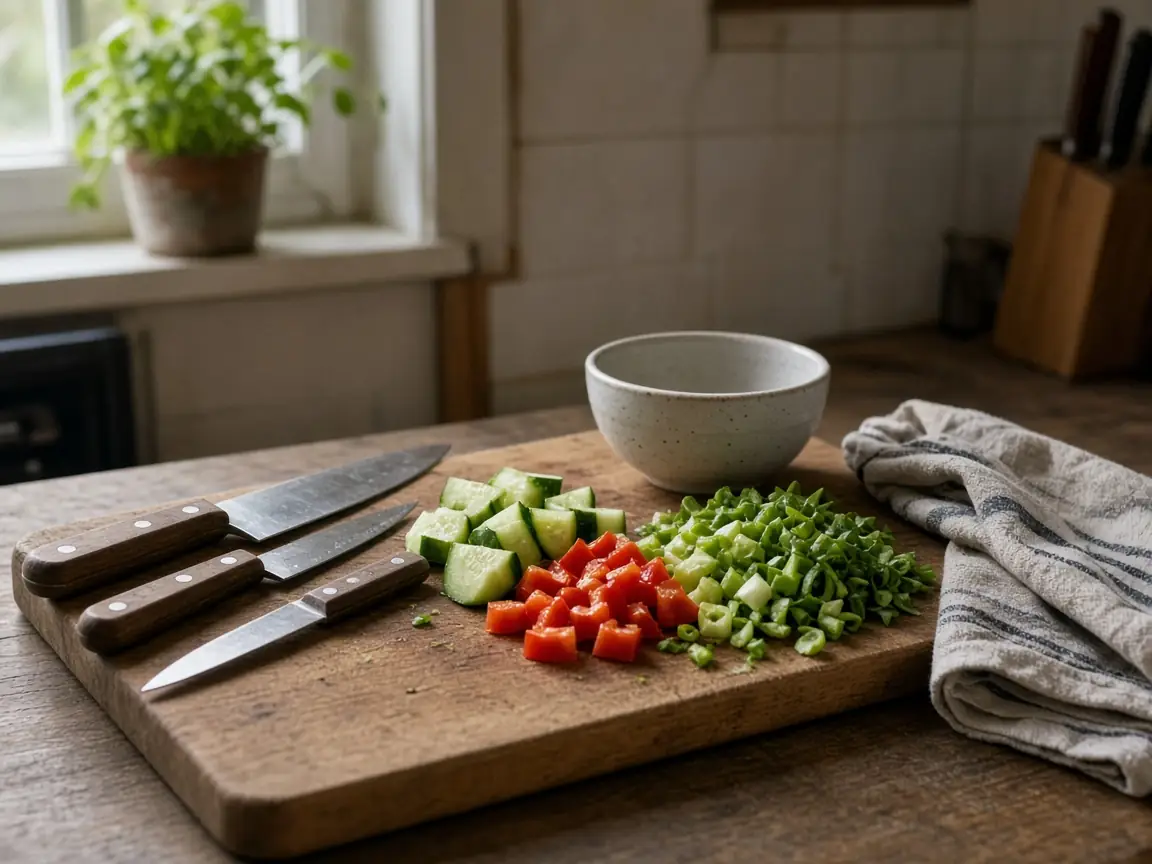
A crowded knife block can make a small kitchen feel even smaller, and most of us do not need one. Three good knives, kept reasonably sharp, will cover nearly every ordinary supper: chopping carrots for Lentil and Carrot Soup, slicing onions for Quick Pickled Red Onions, or cutting fruit for a simple cake.
The aim is not to own the most impressive knife. It is to have a few that feel comfortable in your hand, fit your cupboard or drawer, and do not turn a weeknight onion into an argument. A modest kitchen asks for things that earn their space.
- A cook’s knife for most chopping, slicing and dicing
- A small paring knife for close, fiddly jobs
- A serrated bread knife for loaves, tomatoes and soft fruit
The three knives I would choose
If you are starting from scratch, buy the best cook’s knife you can comfortably afford, then add the others slowly. A blade around 18 to 20 cm is a manageable all-purpose size for many home cooks. It is long enough to cut a cabbage or squash into sensible pieces, but less cumbersome than a very large restaurant-style knife. Look for a handle that feels secure rather than glamorous. If possible, hold it before buying: your hand gets the final vote.
A paring knife with a blade of about 8 to 10 cm is the quiet workhorse. It is useful for trimming mushrooms, peeling ginger, removing strawberry hulls, cutting garlic, and dealing with the small patches a larger knife cannot reach. It is also the knife I reach for when making Quick Pickled Red Onions, where neat trimming matters more than speed.
A serrated bread knife is not only for bread. Its saw-like edge cuts through crusts without squashing the soft middle, and it is especially handy for ripe tomatoes, citrus, peaches and layered cakes. A medium-length knife is plenty for a small flat; it need not be the length of a fencing foil.
- Optional fourth knife: a flexible filleting knife only if you regularly prepare whole fish
- Optional fifth knife: a sturdy cleaver only if you often tackle large squash, bones or dense roots
- Skip sets with many matching specialist blades unless you know exactly how you will use them
What to look for when buying
A sensible kitchen knife should have a full-sized, comfortable handle and a blade that is not so heavy you tire after ten minutes. Stainless steel is practical for everyday cooking because it is less fussy about damp air and occasional delays at the washing-up bowl. Carbon steel can take a beautiful edge, but it stains and rusts if neglected, which is one more small domestic responsibility than I need on a Tuesday.
Do not worry too much about whether the blade is forged or stamped, provided it is well made and sits straight. Check that the handle has no awkward edges, the blade feels balanced, and there is enough space for your fingers between the handle and chopping board. A knife should feel controlled, not like it is asking to be admired from a distance.
Second-hand shops can be worth a look, particularly for bread knives and solid older cook’s knives. Inspect closely for cracks, loose handles, deep chips and rust around the join. A dull but sound blade can often be restored; a bent or damaged handle is less inviting.
- Choose comfort over a fashionable shape
- Avoid very cheap knife sets with lots of little-used blades
- Buy a blade guard if the knife will live in a drawer
- Keep the receipt and packaging until you know the knife suits you
A safer way to chop
A sharp knife is generally safer than a blunt one. This sounds backwards at first, but a dull edge needs more force and is more likely to skid away from the food. Sharp does not mean reckless: it means the blade goes where you guide it.
Set a damp folded cloth or piece of kitchen paper under your chopping board so it cannot slide. Use a stable board large enough for the task, and clear away dirty bowls, packaging and clutter before beginning. In a small kitchen, a little clear space makes a surprising difference.
For most chopping, curl the fingertips of your non-knife hand under slightly, with your knuckles facing the blade. Let the side of the blade rest lightly against those knuckles as a guide, and keep the tip of the knife near the board while the handle rises and falls. Start slowly. There is no prize for slicing an onion at the speed of a television cook.
- Cut round vegetables in half to make a flat, stable side before chopping
- Keep the blade pointed away when carrying a knife
- Never try to catch a falling knife
- Use the right tool: scissors, a peeler or your hands can be safer for some jobs
The jobs that blunt or damage a blade
Knives are for food, not for opening tins, prising apart frozen burgers, scraping burnt bits from a tray or hacking through hard bones. These are quick routes to chips and a grumpy edge. If you need to move chopped food from the board, turn the knife over and use the blunt spine rather than dragging the sharp edge across the surface.
A wooden or plastic chopping board is kinder to knives than glass, marble, ceramic or an uncovered baking tray. Glass boards are easy to wipe, but they are rather like chopping on a plate: the knife loses the argument every time.
Use the serrated knife for crusty bread and squishy tomatoes, and the cook’s knife for firmer produce, herbs, meat and everyday slicing. Let the paring knife handle close, controlled work. This division is not strict, but it makes each knife last longer.
- Do not put good knives loose in a washing-up bowl
- Avoid cutting directly on worktops or plates
- Wash knives soon after using them, especially after acidic foods
- Dry them fully before storing
Washing, storing and sharpening
Hand-wash knives with warm water, washing-up liquid and a sponge, keeping the sharp edge angled away from your fingers. Dry them immediately with a tea towel. Even knives labelled dishwasher-safe tend to fare better outside the dishwasher, where heat, detergent and rattling against other cutlery can spoil handles and edges.
For storage, a drawer insert, magnetic strip or individual blade guards will do. In a small kitchen, a slim magnetic strip can free up valuable worktop room, but mount it securely and keep it out of reach of children. Avoid tossing knives into a drawer together; it damages the edges and makes retrieving one needlessly risky.
A honing steel straightens a slightly rolled edge; it does not properly sharpen a worn blade. Use it gently and only if you are confident with the motion. For most home cooks, a simple pull-through sharpener used carefully, a whetstone with some practice, or an occasional professional sharpening service is enough. If your knife crushes a tomato rather than slicing it, it is asking for attention.
- Wash by hand and dry at once
- Store blades so they cannot knock together
- Hone occasionally, but sharpen when the knife genuinely feels dull
- If in doubt, have a favourite knife sharpened professionally rather than experimenting on it
The useful test
A good knife collection should make cooking calmer, not more technical. With a cook’s knife, paring knife and bread knife, you can get through vegetable soups, salads, sauces, toast, cakes and most simple suppers without rummaging for a special gadget.
Choose knives that suit your hands, protect their edges, and sharpen them before frustration sets in. They do not need to look dramatic on the wall. They simply need to be ready when there are leeks to slice, carrots to chop and dinner to get on the table.